Verdent: The World's First AI Engineering Team for Builders
SINGAPORE, April 20, 2026 /PRNewswire/ -- Most builders do not fail because they lack ideas. They fail because there is always a gap between the idea and the thing that actually ships, and closing that gap has traditionally required a team.
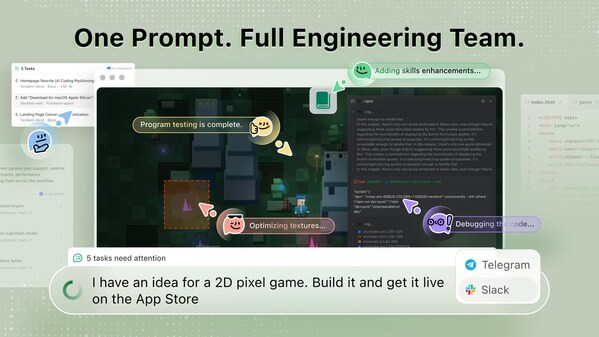
Verdent: The World's First AI Engineering Team for Builders
Today, Verdent announced a major update to its AI-native software platform, expanding its capabilities beyond code generation to support planning, execution, validation, and delivery in a more unified workflow. The update reflects the company's view that the next phase of AI in software development will not be defined by better copilots alone, but by AI engineering teams that can help carry work from intent to outcome.
A photographer in Europe built a custom e-commerce platform and parent-facing CRM from scratch, with no engineering background. An equipment supplier in India shipped a multi-role workflow system and billing app for his factory floor. A consultant in West Africa delivered three client projects in parallel: an education platform, a bank CRM, and a corporate intranet. Together, they reflect what early Verdent users around the world are already doing: building real software without hiring engineers.
That is the opportunity Verdent is built around.
AI coding tools changed how software gets written. They made code generation faster, cheaper, and more accessible. But they did not solve the hardest part of software development: deciding what to build, coordinating how it gets built, validating what changed, and carrying work all the way through to something teams can actually ship.
Verdent starts from that premise. The company believes the next chapter of AI in software development will not be defined by isolated assistants or better autocomplete. It will be defined by AI engineering teams—systems that take on planning, execution, validation, and delivery as a unified workflow.
Rather than answering isolated prompts or generating one-off snippets, Verdent is designed to carry software work across the full path from intent to outcome. Describe what you want to build—a dashboard, a CI/CD pipeline, a feature rollout, or an internal tool—and Verdent gets to work. It breaks the goal into tasks, selects the right tools, writes and modifies code, runs tests and checks, and returns working output teams can review and ship.
Where other tools stop at the prompt, Verdent operates more like an AI engineering team. It carries work across complete workflows, retains context across projects, and keeps moving forward without forcing users to start from scratch every time. Instead of treating each request as a cold start, Verdent keeps track of codebase structure, conventions, prior decisions, and user preferences, allowing work to progress with greater continuity and consistency.
That continuity extends beyond the desktop. Verdent works asynchronously through tools like Slack and Telegram, allowing teams to trigger and monitor work outside a traditional development environment. Progress does not stop when you step away from your computer. It continues while founders and small teams are focused on product decisions, customer conversations, operations, or go-to-market work.
This is what makes the AI engineering team metaphor meaningful. The value is not just in generating code. It is in helping move software delivery forward across planning, execution, validation, and deployment—even when no traditional engineering team is there to carry the load.
"Code generation is abundant," said Zhijie Chen, founder and CEO of Verdent and former Head of Algorithms at ByteDance. "What remains scarce is completion—software that is planned, executed, verified, and shipped. We believe the industry is moving beyond copilots. Verdent is built around an AI engineering team model for software delivery."
Verdent's product direction is also informed by research into how AI systems make decisions across real engineering workflows. The company's work on SEAlign received a Distinguished Paper Award at ICSE 2026, one of the leading conferences in software engineering. That research focuses on aligning AI systems with the decision-making demands of real engineering work—reasoning through multi-step tasks, incomplete information, and practical constraints rather than optimizing only for code generation in isolation.
"Agent success is not just about stronger models," said Huangzhao Zhang. "It is about making better decisions across the plan-code-verify cycle. That is the direction that shaped Verdent."
Software development is entering a new phase. The copilot era taught AI how to assist. The next phase will demand systems that can take on more of the path from intent to outcome.
Verdent is built for founders, indie developers, and small teams with more backlog than bandwidth—teams constrained less by ideas than by the effort required to turn those ideas into working, reliable software.
Not another AI coding assistant.
An AI engineering team for builders.
About Verdent
Verdent AI is an AI-native software company building tools that help developers move from idea to shipped product. Designed around chat-first workflows, parallel work, and trusted review, Verdent supports desktop development as well as VS Code and JetBrains environments. The company's mission is to help developers focus on creation while AI takes on more of the work across the software lifecycle.
Media Contact
Eileen Li
Verdent AI
eileen@verdent.ai
Source: Verdent AI